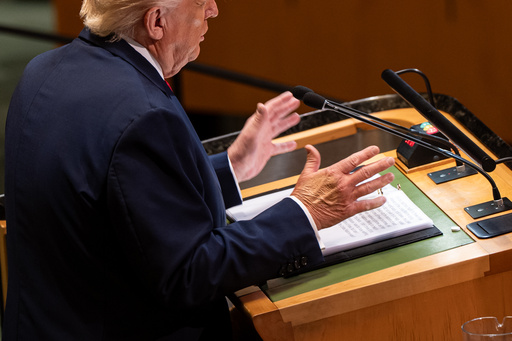


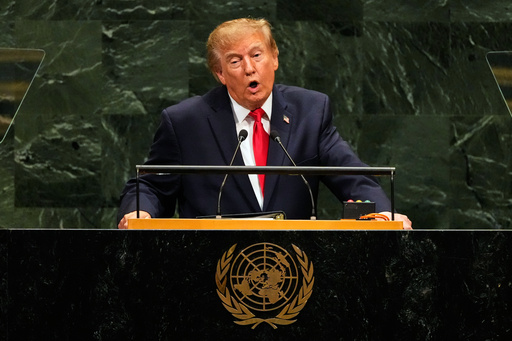
President Donald Trump addressed the U.N. General Assembly on Tuesday at a tumultuous moment for the world — and for his presidency. After his speech to the annual gathering of world leaders, Trump was expected to hold talks with new British Prime Minister Andy Burnham, Japanese Prime Minister Sanae Takaichi and a more informal meeting with Venezuela’s acting president Delcy Rodríguez, according to the White House.
Also, Trump is hosting Chinese leader Xi Jinping in Washington this week as economic and tech competition escalates between the two countries. Both leaders are aiming to stabilize fragile ties, though no major agreements are expected. The meeting itself is seen as significant given the deep differences and a lack of trust between the United States and China.
Here's the latest:
In a speech Tuesday at the U.N. General Assembly in New York, King Abdullah II said Israel was displaying an “expansionist appetite” that was threatening its neighbors.
Jordan, which signed a peace treaty with Israel in 1994, has long called for a resolution to the Palestinian-Israeli conflict and the establishment of a Palestinian state.
“For decades, I have stood before this General Assembly and warned of the dangers of leaving the Palestinian-Israeli conflict unresolved, but the international community has chosen to manage the conflict rather than confront it,” Abdullah said.
He called the “destruction in Gaza and the de facto annexation of lands in the West Bank” an “attempt to erase the Palestinian presence,” and said the Israeli goal was to make establishing a Palestinian state “impossible.”
“Forcibly removing Palestinians from their homes in the West Bank is forced displacement,” he said, adding his country will “continue to support the Palestinian resistance.”
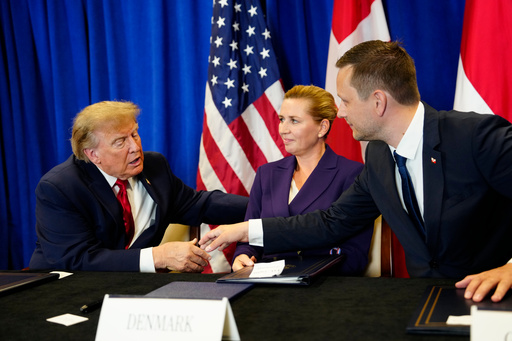
Speaking during Tuesday’s signing ceremony, Trump called the deal to boost the U.S. military’s presence in Greenland “tremendous for Europe and the United States and everybody and for Greenland.”
“It’s going to be incredible,” Trump said. “And the people of Greenland have been so nice. The people of Denmark have been amazing.”
Trump faced resistance earlier this year when he had threatened to take Greenland by force. Leaders of the self-governing territory of Denmark, with a population of about 56,000 people, said it was not for sale.
Greenlanders had mixed reactions when Trump first started talking about acquiring the territory. In Denmark, many expressed relief following last week’s announcement of the deal.
As he was leaving the ceremony, Trump did not answer a question about whether he had taken the threat off the table.
Jens-Frederik Nielsen said at the signing ceremony that “it takes into account the people of Greenland, our rights, our livelihoods and the development of our country.”
Nielsen said that was a key priority for Greenland throughout the process, which was marked by tensions over Trump’s designs on the semiautonomous territory of Denmark.
Danish Prime Minister Mette Frederiksen says the agreement “represents a milestone” in her country’s longstanding cooperation with the United States.
“This deal is good for the United States, it’s good for Greenland, Denmark, for the NATO alliance and therefore also good for Europe,” she said in remarks before leaders from the three countries signed it.
The agreement is set to give the U.S. military a larger footprint on Greenland, a semi-autonomous territory of Denmark, though it falls short of the total control of the island that Trump had sought after returning to office.
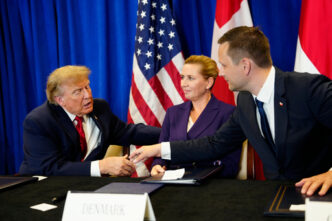
President Trump signed the agreement with Denmark and Greenland aimed at strengthening Arctic and North Atlantic security, easing tensions over his repeated calls for Greenland to become part of the United States.
The signing Tuesday on the sidelines of the U.N. General Assembly in New York comes days after Trump announced the deal to bolster U.S. military presence on the vast, icy island but keep it under Danish control. The governments provided few details of the agreement before the signing.
For months, Trump has expressed his desire for Greenland to become part of the United States and issued threats to seize the semiautonomous territory from Denmark, a NATO ally.
There was an unusual playlist before Trump was set to sign an agreement giving the U.S. the ability to expand its military presence on Greenland.
As aides and media awaited the leaders for the signing, they listened to a cover of “Send in the Clowns.” That ballad is from the musical “A Little Night Music” and includes the lyrics:
“Sorry, my dear,
But where are the clowns?
Quick, send in the clowns.
Don’t bother, they’re here.”
Other tracks included “One More Night” by Phil Collins and “I Wanna Know What Love Is” by Foreigner.
Democratic attorneys general from California and New York are suing the Trump administration over its plans to buy back offshore wind leases as Trump seeks to discourage the expansion of wind energy in favor of fossil fuels.
California Attorney General Rob Bonta said he’s suing over removal of a project off his state’s coast planned by Chicago-based Invenergy. The Trump administration said in June that it’s buying back the company’s U.S. offshore wind leases for four wind projects.
New York Attorney General Letitia James, meanwhile, led seven states in suits seeking to block two deals that would hand energy companies $1.4 billion in exchange for the cancellation of four planned offshore wind projects. One challenges a deal with Bluepoint Wind and the other challenges a deal with Invenergy.
James called the deals illegal and said they will ultimately increase Americans’ electricity bills by sabotaging states’ ability to meet growing energy demands.
A student activist scaled a light pole on Pennsylvania Avenue, four blocks away from the U.S. Capitol in the rain Tuesday morning to hang banners in protest of the Chinese government.
Organizers say it was meant to “unwelcome” Chinese leader Xi Jinping ahead of his Wednesday arrival to Washington to meet with President Trump.
One banner said, “Dictator Xi Your empire will fall Free Tibet.” Another said, “Dictator Xi: You are not welcome.”
The protester was taken into police custody later.
Thousands of protesters are expected to gather in Washington this week to protest Beijing’s policy and practices in Tibet, China’s ethnic region of Xinjiang, Hong Kong and what it calls human rights abuses.
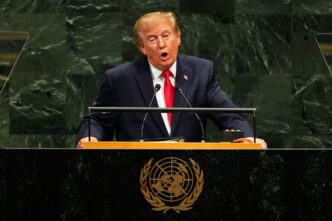
And in contrast to his typical addresses, he rarely deviated from the script in his roughly 40-minute speech.
Trump read key parts of the speech almost exactly how they were presented in excerpts released to the media ahead of time.
One example: “While others have talked, I have acted. While others have spoken of peace, I have made peace.”
The U.S. president said he would “officially” change the name of artificial intelligence, saying the existing name makes the technology seem “fake.”
“The use of the word artificial makes intelligence fake, it makes it sound fake and it is not fake. It’s actually amazing,” Trump told other world leaders at the United Nations.
It’s not clear yet if there was an official order making the change, but it would likely mean adjusting the name of the “AI Force” that Trump announced this weekend to the “SI Force.”
The president said at the U.N. that from this “point forward,” U.S. government documents “will be changed to use the much more accurate term super as opposed to artificial. So it’s super intelligence.”
During his United Nations speech, Trump denied the U.S. military is running low on advanced weapons because of the Iran war. But that has been contradicted by experts and allies alike.
“We have more munitions than we could ever possibly even think of using, and we’re building them at levels that we have never done before,” Trump said.
Experts, however, say weapons stockpiles are diminishing and that it’ll take years to replenish Tomahawk cruise missiles as well as Patriot and THAAD missile interceptors.
Depleted stockpiles have caused alarm in Europe, where U.S. and NATO officials have told The Associated Press there is a “beyond critical” shortage of missile interceptors. Saudi Arabia also is running low on interceptors and has turned to allies for help.
The U.S. president pledged in his speech at the United Nations’ General Assembly that Russia’s war in Ukraine would soon end.
“We’re working very closely with the leaders of Russia and Ukraine, and we will get that one done,” Trump said. “It’s going to happen, I think, more quickly than people understand.”
The war began in early 2022 with Russia’s invasion of Ukraine. Trump has repeatedly suggested peace was at hand since returning to the White House in 2025, only for the conflict to continue.
“Will a deal be made with Iran that lets them rebuild and create a far greater country than it ever was before?” Trump asked.
“Or do I annihilate the Islamic Republic and do it quickly, never giving them a chance to kill and destroy people and countries again?”
The president continued: “Do I drive them into hell?”
Trump said he believes Tehran will “make a deal right after the election” in November.
Trump says he’s not worried that the war in Iran will undermine the Republican Party’s chances in the midterm elections. In fact, he says, the election “doesn’t even enter my mind” when it comes to Iran.
Polling suggests the unpopular war is making it more difficult for the GOP to maintain control of Congress. Republicans in some states have also started to speak out against the war.
Still, Trump insisted Tuesday that he’s not concerned with politics.
“They’re waiting to see how I do in the midterm election,” Trump said of Iran. “What they don’t realize is that I’m not running. I did that already, and won in a landslide … and I’ll be here for two-and-a-half years.”
As Trump began to describe the last six months of on-and-off military strikes against Iran, the delegation of Iranians began to walk out, with only one person remaining seated.
Iranian President Masoud Pezeshkian and Foreign Minister Abbas Araghchi are in New York for the annual meeting but didn’t arrive in the General Assembly hall for Trump’s speech. Instead, lower level staff and delegates were seated when he began to speak, only to leave 10 minutes into his speech.
The president opened his speech at the United Nations with more of a campaign stump-style speech, largely overlooking foreign affairs to focus on his domestic track record on the economy, immigration and crime.
“I can report to you with pride that America is back and our country is stronger today than ever before,” Trump said. “Our technology is second to none, and we are leading in virtually everything.”
Trump talked about the U.S. stock market performance, the 2025 decline in the official U.S. poverty rate, his efforts to stop illegal crossings on the southern border and reduced violent crime rates in American cities.
The venue has been set up for the signing of an agreement between the United States, Denmark and Greenland aimed at strengthening Arctic and North Atlantic security.
Photos from the room in the United Nations headquarters showed a small table with three chairs and place markers. Denmark is placed in the center, between the United States and Greenland.
The signing follows prolonged tensions over U.S. President Donald Trump’s interest in Greenland, a semiautonomous territory of Denmark.
The Ukrainian president thanked the group including Sen. Jeanne Shaheen, D-NH, Sen Richard Blumenthal, D-Conn., and others for the strong bipartisan support in Congress for the Russia sanctions package Trump signed into law.
“When it can be fully implemented, peace and guaranteed security will definitely become closer,” he posted on X.
They met Monday in New York.
It’s standing room only inside the massive General Assembly hall ahead of the Republican president’s speech to the world body. Diplomats, delegates and staff lined the corners and stairwells of the oval shaped room to see the first world leaders take the massive stage.
The Trump administration has spent the last year-and-a-half blasting the institution, saying it has failed to live up to its potential while issuing massive cuts to its programs and initiatives.
This year, Trump is arriving to the U.N. as the U.S. struggles to end a more than six-month war with Iran that’s wreaked havoc on the global economy and once again thrown the Middle East into chaos.
Sitting in the U.S. section are some members of the U.S. mission as well as Treasury Secretary Scott Bessent.
Excerpts from Trump’s upcoming speech to the U.N. General Assembly read: “The Cuban regime has also spent decades coordinating with left-wing radicals and Communist networks here in the United States.”
Provided by a White House official, the excerpts accuse Cuban officials of having “cultivated ties to subversive and radical groups” like the Communist Party USA, Antifa and democratic socialists.
Facing low approval ratings, Trump argues that many top Democrats are aligned with communists, hoping it can lift Republicans ahead of the midterm elections.
Trump has long suggested that Cuba’s communist government may collapse without U.S. intervention. But, with the war in Iran still ongoing, his administration mostly hasn’t turned its full attention to the situation on the island.
Republican Sen. John Curtis of Utah has called on the Senate Judiciary Committee to launch an investigation into Donald Trump Jr.
Curtis’ letter sent Tuesday asks the committee to probe whether Trump Jr. used his proximity to the presidency for financial benefit, which comes after his recent wedding party was partially bankrolled by a Russian oligarch.
He called for the same scrutiny of Hunter Biden, former President Joe Biden’s son.
“The country should not have to accept one standard for the family of a Republican president and another for the family of a Democratic president,” Curtis wrote.
The letter comes after ProPublica reported last week that Umar Kremlev, who has close ties to Russian President Vladimir Putin, helped pay for festivities when Trump Jr. and socialite Bettina Anderson were married in the Bahamas in May.
President Trump defended Kremlev’s involvement but said the money would be paid back.
The president might have banned CNN from accessing the White House, but he faced questions from the network’s Kaitlan Collins as soon as he entered the United Nations to address the General Assembly.
“I’m surprised that CNN is here,” the president said. “You should not be here.”
Trump has banned CNN, MS NOW and Politico from the White House. Those news outlets are suing the president for violating the First Amendment.
In his address to the General Assembly, he told superpowers to recognize “that their power isn’t so super.”
Recent years have made it clear that “military power alone cannot secure peace,” he said.
The annual high-level gathering at the U.N. General Assembly will be consumed with wars in Iran, Gaza, Ukraine,Sudan, Congo and Myanmar and a persisting question: Can the leaders do anything to end them?
U.S. Secretary of State Marco Rubio says the U.S. military should have at least two bases in Greenland following President Trump’s announcement of a deal with Denmark to bolster the U.S. military presence there.
Rubio told WABC radio that American forces will focus in large part of missile defense because he said missiles launched at the U.S. would come over the Arctic. He said the U.S. has a base in Greenland that can be built up and another that can be restarted.
Rubio said the deal allows the U.S. “to put as many military bases as we need in order to defend everything.” He also said the U.S. will screen companies aiming to invest in Greenland to block those with links to China or other non-NATO adversaries.
U.N. Secretary-General António Guterres is pleading for “a world built on interdependence” as he makes his final address to the General Assembly gathering of world leaders.
The U.N. leader has long implored leaders not to give up on cooperation and shared decision-making in the face of accelerating global challenges and increasing great-powers competition. Tuesday’s message took on additional urgency because he leaves office at the end of this year.
“The fault lines in our world are widening,” he said, citing geopolitical divides, wars, climate change and artificial intelligence. But instead of letting the future continue to veer toward fragmentation, transactionalism and mistrust, he called for “a world built on interdependence — and sustained by a dense web of economic, political, social and technological connections.”