

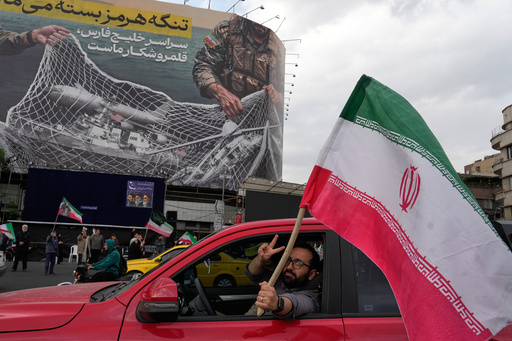
President Donald Trump said Monday that the U.S. military has begun a blockade of all Iranian ports and coastal areas and Iran responded with threats on ports in the Persian Gulf and the Gulf of Oman. Trump had vowed earlier to block the Strait of Hormuz entirely.
Trump later suggested he was willing to engage with Iran, saying he had spoken to “the other side.” This came after he warned on social media that Iranian warships coming “anywhere close” to the U.S. blockade would be destroyed.
Ceasefire talks between the U.S. and Iran ended Sunday without an agreement, raising questions about what happens when the current two-week truce expires on April 22. The Israeli military, meanwhile, pushed ahead with its offensive in southern Lebanon, engaging in fierce fighting with Hezbollah militants over a strategic town, while the group fires rockets and drones at northern Israel.
Here is the latest:
China’s exports grew 2.5% in March from a year ago, significantly slowing from the previous two months as uncertainties rose from the Iran war and its impact on energy prices and global demand.
The March export data released by China’s customs agency Tuesday missed analysts’ estimates and was sharply down from the 21.8% export growth recorded for January and February.
Technology-related exports including a jump in shipments of semiconductors from China on the global artificial intelligence boom have powered its robust exports in early 2026, but economists say impacts from the prolonged Iran war could affect overall global demand for Chinese exports this year.
Israel’s military said a reserve soldier was killed and three others wounded in fighting in southern Lebanon.
The military said late Monday that the reservist killed was a firefighting vehicle driver.
The death brought the number of Israeli soldiers killed in the current war in Lebanon to 13.
Pakistan has proposed hosting a second round of talks between the United States and Iran in Islamabad in the coming days, before the end of the ceasefire, two Pakistani officials said.
The officials, who spoke on condition of anonymity because they were not authorized to discuss the matter with the press, said the proposal would depend on whether the parties request a different location.
One of the officials said that, despite ending without an agreement, the first talks were part of an ongoing diplomatic process rather than a one-off effort.
— By Munir Ahmed
U.S. Vice President JD Vance said in an interview with Fox News Channel’s “Special Report” that negotiations “did make some progress” in the Islamabad talks on the U.S. insistence on the removal of nuclear material from Iran as well as a mechanism to ensure uranium cannot be enriched in the future.
“They moved in our direction,” Vance said in the interview. He said he thought Iranian negotiators were “unable to cut a deal” and needed to get approval from others in Tehran.
Vance also said that U.S. negotiators made clear that Trump “would be very happy if Iran was treated like a normal country, if it had a normal economy,” but he did not go into details about what he meant.
“There really is, I think, a grand deal to be had here. But, it’s up to the Iranians, I think, to take the next step,” Vance said.
The White House was not responsive to queries about whether new talks were being weighed.
“President Trump, Vice President Vance and the negotiating team have made the U.S. red lines very clear. The Iranians desperation for a deal will only increase with President Trump’s highly effective Naval blockade now in effect,” White House press secretary Karoline Leavitt said.
The sides are weighing new in-person negotiations in a bid to reach a deal aimed at ending their six-week war before the ceasefire expires next week, two U.S. officials and person familiar with the development said.
The three said discussions were still underway about a new round of talks, while a diplomat from one of the mediating countries went further to say Tehran and Washington have agreed to it.
All four spoke on condition of anonymity to discuss sensitive diplomatic negotiations.
It’s unclear if the same level of delegation would be expected to attend, the diplomat and U.S. officials said.
The diplomat and U.S. officials said Islamabad, Pakistan, was once again being discussed as the host location. The U.S. officials also said Geneva was a possibility, and that while the venue and timing had not been decided, the talks could happen Thursday.
The White House didn’t immediately respond to a message seeking comment.
Trump told reporters earlier Monday that “we’ve been called by the other side” and “they want to work a deal.”
— By Farnoush Amiri, Aamer Madhani and Matthew Lee
Iran’s representative to the United Nations has demanded compensation from countries it says participated in the U.S. and Israeli war effort against Iran.
Iran’s state media report the nations include Bahrain, Saudi Arabia, Qatar, the United Arab Emirates and Jordan.
Iran’s official news agency, IRNA, said that the U.N. representative, Amir-Saeid Iravani, claimed the countries had violated international law and had to “make full compensation for the damages caused to the Islamic Republic of Iran, including payment of compensation for all material and moral damages resulting from their international violations.”
A majority of U.S. Catholic voters supported Trump in his 2024 presidential victory.
Yet across the broad Catholic political spectrum – even among conservative-leaning bishops – there is dismay over Trump’s unprecedented verbal assault on Pope Leo XIV, the first American to lead their church.
Leo says he is sharing a Gospel message and not directly attacking Trump or anyone else with his appeals for peace and criticism of attitudes fueling the Iran war.
Criticism of Trump came from Archbishop Paul Coakley, head of the U.S. Conference of Catholic Bishops, and from Minnesota-based Bishop Robert Barron, who only a few days ago was applauding Trump as an Easter guest at the White House.
Barron called the president’s remarks “entirely inappropriate and disrespectful” and urged him to apologize.
“They do need a plan for how to wind this down, how to get an outcome that actually leads to a safer, more secure Middle East and, by extension, a stronger national security position for the United States,” the Senate majority leader told reporters after returning from a two-week recess Monday.
On Trump’s blockade of ships entering or leaving the Strait of Hormuz, Thune said that “penalizing those who do business with the Iranians may get people’s attention,” including China, which depends on energy in the region.
“That probably more than anything else right now, is going to be the key issue to resolving the situation, getting the Iranians to the table,” Thune said.
Senate Majority Leader John Thune says it’s his understanding that a potential request from the White House to pay for the Iran war has been scaled back, but he did not give a specific number.
Congress is still waiting for the request, which could total hundreds of billions of dollars. The Pentagon sent the White House a request for $200 billion last month, but Trump has not yet asked Congress to approve any new amount for the war.
Thune, a Republican from South Dakota, told reporters that the request will be an “inflection point” for Republicans, as Congress will have to vote to approve it. That is a “power that Congress has to influence what happens there,” he said.
The U.N. humanitarian office reports that Israeli authorities reopened the Zikim crossing into northern Gaza for the first time in more than 40 days, the U.N. spokesperson said.
Five international aid groups recently said humanitarian conditions in Gaza have deteriorated further since the Iran war began.
Over the weekend, supplies were unloaded, and the U.N. resumed collecting the cargo inside Gaza on Monday, starting with food, nutrition products and other humanitarian items, spokesperson Stephane Dujarric said.
Opening the Zikim crossing “will help address a critical need by allowing supplies to enter northern Gaza directly, so we don’t have to truck them from the south,” where Kemen Shalom is the only other crossing open for goods, he said.
But despite the opening, Dujarric said, “Major constraints remain.”
He pointed to Israeli customs clearance delays, insufficient screening capacity, which makes approval for critical items difficult, and blanket bans on some U.N. agencies and partner organizations “that are central and critical to the joint humanitarian response in Gaza.”
The directors of the International Monetary Fund, the World Bank and the International Energy Agency said Monday that the war’s damage to energy facilities could keep fuel and fertilizer prices high for “a prolonged period.”
Fatih Birol, executive director of the IEA, said the disruptions to oil supplies from the conflict is “the greatest energy security challenge in history.” One-third of the 80 Mideast energy facilities his agency is monitoring have been damaged.
Birol spoke at IMF headquarters after meeting with Kristalina Georgieva, managing director of the IMF, and Ajay Banga, president of the World Bank.
Birol warned that April could be worse than March for the world economy because many fuel shipments from before the war were still arriving in ports last month.
U.S. oil prices were $98 a barrel in afternoon trading, after topping $100 earlier Monday.
But military officials have offered few details about how a blockade of Iranian ports would actually work.
Aside from the aircraft carrier USS Abraham Lincoln, the U.S. Navy has 11 destroyers, three amphibious assault ships, and a littoral combat ship, all in the waters of the Middle East, a defense official said.
A second defense official says no U.S. warships are in the Persian Gulf — the body of water that forms most of Iran’s coastline.
Both officials spoke on condition of anonymity to discuss sensitive military operations.
Trump said the blockade had taken effect Monday.
The second defense official pointed to a notice to mariners as a more accurate representation of the military’s plans. It says access to Iranian ports is being restricted, but how these measures “will be applied in practice … are in development.”
— By Konstantin Toropin
The S&P 500 rallied 1% Monday and is back to within 1.3% of its record. The Dow Jones Industrial Average added 0.6%, and the Nasdaq composite rose 1.2%.
Even in the oil market, where prices jumped above $100 per barrel after ceasefire talks failed to end the war, prices pared their leaps as Monday progressed. The moves for financial markets overall were much more modest than the extreme swings that have hit since the war began in late February.
Blockades alone typically don’t settle military conflicts, but they can be a way of exerting pressure on an adversary’s economy, experts tell the AP. That’s likely President Donald Trump’s intention in declaring a U.S. blockade of Iranian ports.
Blockades are “very much a gradual tool,” said Sidharth Kaushal, a naval power expert at the Royal United Services Institute defense and security think tank in London.
Throughout history, blockades have been a way for one power to drain another’s economy by disrupting the flow of goods in and out of a country. But they take time, and can also require significant resources by the blockading force.
“It’s a form of economic warfare,” said Raul Pedrozo, professor of international law at the U.S. Naval War College.
To meet international law, a blockade of the Strait of Hormuz must be officially announced and effectively and impartially enforced, legal experts tell the AP.
“You have to apply it to everybody going in and out of Iran,” said Raul Pedrozo, professor of international law at the U.S. Naval War College. “It doesn’t just apply to people we don’t like.”
The requirements are to warn mariners of any blockade and ensure it is enforced fairly and responsibly. International law experts will also be watching to see if the U.S. allows humanitarian aid, food or medicine to reach Iran.
“How it is carried out will determine whether it is lawful or not,” Todd Huntley, a retired Navy captain and director of Georgetown University’s National Security Law Program.
The Israeli leader says the war against Iran was a powerful contrast to the Holocaust.
In an address marking Israel’s annual Holocaust memorial day, Netanyahu said that while Jews were like an “abused animal crying in agony” at the hands of the Nazis, the modern state of Israel fights back against its enemies.
He then listed several Iranian nuclear sites alongside Nazi death camps.
“Had we not acted, the names Natanz, Fordow, Isfahan and Parchin might have been remembered eternally in infamy, just like Auschwitz, Treblinka, Majdanek, and Sobibor,” he said.
Netanyahu often uses the annual address to lash out at Iran.
During a panel on Monday, Finland’s President Alexander Stubb said that he “sees no signs” of America abandoning the trans-Atlantic alliance despite Trump’s threats over NATO countries’ refusal to help with the Strait of Hormuz.
“So don’t underestimate the interest of the United States to stay engaged with the alliance,” Stubb said at an event at the Brookings Institution.
The European leader has often leveraged his good relationship with Trump — the two men have played golf together and speak regularly — to argue against his “America First” posturing. Stubb also reiterated that a “coalition of the willing” would help ensure the critical waterway was opened after the war ended.
“It’s my job as president of Finland to try to save the situation and convince the Americans that without allies, it’s difficult to project power,” he said.
The vessel-tracker MarineTraffic said in a post on the social platform X that the ships reversed course within minutes of approaching the critical waterway, shortly after the U.S. blockade began.
It said one of the tankers departed the United Arab Emirates’ Sharjah anchorage on Monday, bound for China. It was not immediately clear where the second vessel was headed.
It’s not just gas prices: Some U.S. water utilities are reporting that the war is disrupting their ability to maintain recommended fluoride levels in the drinking water.
The Association of Metropolitan Water Agencies says it expects additional shortages as the war stresses the supply chain. Israel is a major supplier of the chemical used to fluoridate drinking water.
The number of water utilities affected so far is small, but the shortage is affecting hundreds of thousands of people.
Dentists say a short-term drop in fluoride levels should be fine for most people, but longer-term disruptions could put Americans, especially young children, at higher risk for tooth decay.
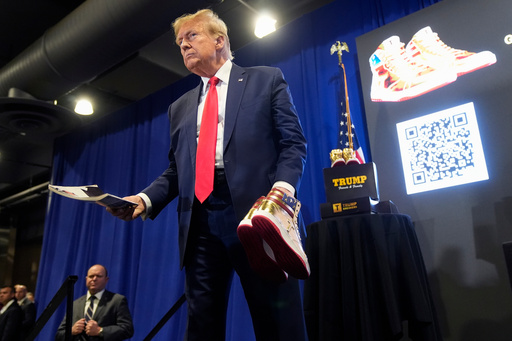
Speaking outside the Oval Office on Monday, Trump suggested the U.S. is still willing to engage with Iran to negotiate a resolution.
“I can tell you that we’ve been called by the other side,” Trump said, adding, “We’ve been called this morning by the right people, the appropriate people, and they want to work a deal.”
Trump did not say who called or what was discussed.
“We can’t let a country blackmail or extort the world because that’s what they’re doing,” Trump said of Iran.
Trump repeated his argument that safeguarding the strait is of greater concern to other parts of the globe than the United States. The effective closure of the strait since the start of the war, however, impacts global oil prices — which has led to surging gas prices for American motorists and rising inflation on other goods.
“We don’t use this strait,” Trump said. “We have our own oil and gas, much more than we need.”
Trump is refusing to apologize for sharply criticizing Pope Leo, saying that the pontiff “went public” in his criticisms of the war in Iran, and “I’m just responding.”
In comments to reporters outside the Oval Office, Trump added, “There’s nothing to apologize for” and said of Leo, “He’s wrong.”
Trump was also asked about posting an image of himself as a saintlike healer, which seemed to draw comparisons between himself and Jesus Christ.
The image was posted Sunday night and drew widespread condemnation from Evangelical Christian leaders and has since been taken down.
Trump said, “I did post it.” But he suggested it had something to do with the Red Cross and insisted: “It’s supposed to be me as a doctor making people better.”
Foreign Ministry spokesperson Esmaeil Baqaei derided the blockade as a “revenge of choice” against the global economy.
“Is it ever worthwhile to cut off one’s nose to spite one’s face?!” he wrote on the social platform X.
The closure of the strait severely crimped output from OPEC last month. The 12-nation oil cartel, with members in the Middle East, Africa and Venezuela, said Monday that production tumbled by 7.89 million barrels a day in March, to 20.79 million barrels.
“Disruptions to shipping operations in the region raised persistent concerns about regional supply flows, while strong buying of prompt spot market barrels, production cuts, and declarations of force majeure further supported the upward price momentum,” OPEC said.
The organization said demand appears to be steady this year, but cut its forecast for the current quarter, citing the war.
Shosh Bedrosian told reporters Monday that Israel’s upcoming talks with Lebanon will focus on disarming Hezbollah and establishing peaceful relations between the two countries.
“We will not discuss a ceasefire with Hezbollah, which continues to carry out indiscriminate attacks against Israel and our civilians,” she said.
Israel and the Lebanese army have both been unable to forcibly disarm Hezbollah.
Efforts are underway to resolve the remaining disputes between Washington and Tehran as a two-week ceasefire brokered by Pakistan remains intact, said the country’s prime minister, Shehbaz Sharif.
In televised remarks at a Cabinet meeting, Sharif cautioned that peace efforts take time, citing past agreements such as the Geneva accords.
The president made the comment on social media just after the blockade of Iran was expected to begin. Trump said Iran has some “fast attack ships” remaining even after much of its navy was destroyed by U.S. strikes.
“Warning: If any of these ships come anywhere close to our BLOCKADE, they will be immediately ELIMINATED, using the same system of kill that we use against the drug dealers on boats at Sea,” Trump wrote on his Truth Social platform.
He added: “It is quick and brutal.”
The current truce between the U.S. and Iran appears to be holding, with no word on whether negotiations will resume before it expires on April 22.
Pakistan’s foreign minister, Ishaq Dar, said his country will try to facilitate a new round of dialogue between Iran and the U.S. in the coming days. There was no immediate reaction from either side.
A key obstacle seems to be a perception on both sides that they won the war and that each has time on its side.
That’s an increase of 34 deaths since the previous day’s count, according to the Lebanese Health Ministry. It said Monday that among those killed were 252 women, 166 children, and 88 medical workers.
The number of wounded has increased to 6,762 people since the war began on March 2, when Hezbollah fired rockets toward northern Israel in solidarity with Iran, sparking Israel’s ground invasion and aerial bombardment campaign that has displaced over one million people.
Ahead of anticipated direct talks in Washington on Tuesday, the strikes across both sides of the tense frontier and fierce ground fighting in southern Lebanon have intensified.
The U.S. military has vowed to blockade all Iranian ports to pressure Tehran into agreeing to open the crucial Strait of Hormuz and accepting a peace deal. Iran responded with threats on all the ports of U.S. allies in the Persian Gulf and the Gulf of Oman.
The showdown contains serious risks for the global economy and raises the specter that a ceasefire that is currently holding could collapse.
It was not clear if the blockade had started when the designated time of 10 a.m. EDT (2 p.m. GMT) arrived. Minutes earlier, a notice to mariners issued by the United Kingdom Maritime Trade Operations agency, which monitors maritime security, said the restrictions included “the entirety of the Iranian coastline, including ports and energy infrastructure.”
The notice added that transit through the strait “to or from non-Iranian destinations is not reported to be impeded by these measures,” but it added that ships “may encounter military presence” in the strait.